1 · Feasibility
Beads and protocol tested in your workflow
Under a feasibility agreement, with defined success criteria and our application support.
Magnetic microspheres for diagnostics and life sciences
iSpheres develops and manufactures highly monodisperse magnetic microspheres with proprietary surface chemistry and magnetic properties, developed for the most demanding applications. Our first product delivers superior cfDNA isolation without chaotropic salts, without alcohol and without microplastics.
How we commercialize
iSpheres is a component supplier to companies that develop kits, instruments and assays. We design the microsphere and its surface chemistry for the partner's workflow and manufacture it under ISO 13485. The partner integrates it into their product and brings it to market.
What we offer today
1 · Feasibility
Under a feasibility agreement, with defined success criteria and our application support.
2 · Co-development
Coating, magnetic properties and bead format tuned to your protocol. Joint development plan, agreed specifications.
3 · Supply
The validated formulation produced in-house under ISO 13485 and delivered under a supply agreement.
The platform
Every iSpheres bead has the same build: a magnetic iron core, a silica shell and a proprietary polymer coating. Between applications, the coating and the core change. The magnetic workflow around them stays the same.
Architecture
An iron core gives the magnetic response. A silica shell gives a defined, inert surface to build on. Both are inorganic.
Chemistry
A proprietary, patent-protected polymer coating captures nucleic acids and selects them by fragment length. The same surface can be functionalized for other targets.
Magnetism
The magnetic core is designed for the separation the workflow requires. Strength and response are design parameters.
Clean by design
Nucleic acid extraction has relied on the same chemistry for three decades: chaotropic salts to drive binding and alcohol washes to keep it. Many magnetic beads add a third element, a polymer particle. iSpheres removes all three. The coating binds without chaotropic salts or alcohol, and the particle is inorganic.
No chaotropic saltsBinding is driven by the coating
No guanidinium in the workflow. Nothing hazardous to ship, handle or dispose of, and no chaotrope carry-over into the assay.
No alcoholNo ethanol or isopropanol washes
No flammable reagents on the bench or in the instrument, and no alcohol carry-over into downstream enzymatic steps.
No microplasticsThe particle is inorganic
An iron core in a silica shell. No polystyrene, no polymer bead body, nothing that persists as microplastic in the waste stream.
Monodisperse by manufacture
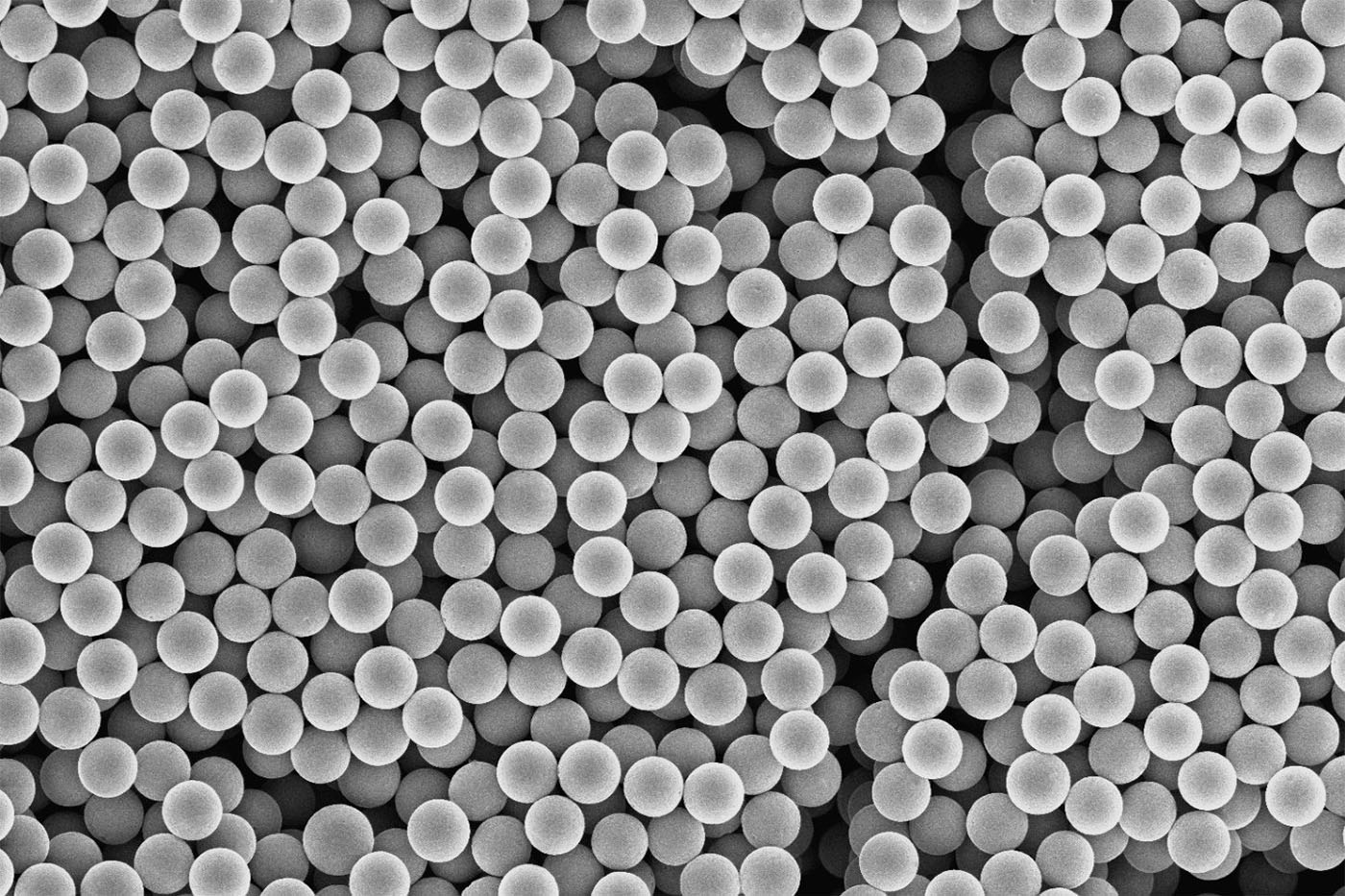
Binding capacity, magnetic response and release kinetics all scale with particle size. A monodisperse population removes size as a variable. That is the basis for batch-to-batch reproducibility and for a workflow whose behavior can be specified in advance.

First product · Cell-free DNA
Tumor- and fetus-derived DNA circulates as short fragments. DNA released from blood cells damaged during sampling and transport is long. Conventional extraction chemistry recovers the short fraction poorly and the long fraction well. The assay needs the opposite.
Performance data are available to partners under NDA.
How the coating separates by length
1 · Bind
2 · Elute
Short DNA
Long DNA
1 · Bind
In the binding buffer, DNA of every length attaches to the polymer coating. A short fragment slips between the polymer chains and is held at a few points. A long fragment lies across the chains and is held at many.
2 · Elute
In the elution buffer, each contact opens and closes on its own. A fragment leaves only when all of its contacts are open at the same moment. For a short fragment with few contacts this happens within the elution step. For a long fragment with many contacts it practically never does.
3 · Result
The eluate contains the short DNA. The long DNA is discarded with the bead. Entry and release act as two independent filters. Each is soft on its own and their combination is decisive, so the result holds from batch to batch. Both come from one coating. Nothing is added to the workflow.
Why less noise matters
Conventional extraction
iSpheres coating
Same blood sample, same number of tumor fragments. Schematic.
A digital PCR reaction takes a fixed input. Contamination in that input displaces signal. When most of it is genomic DNA from damaged blood cells, the few tumor-derived fragments are diluted below what the assay can call, and they must be called against a larger wild-type background. Remove the contamination and the same fragments make up a larger share of what is read. The assay sees them at a smaller tumor burden, at the same input.
That is the purpose of recurrence monitoring: to see the signal while it is still small. The extraction determines how much signal reaches the assay.
Where it matters
Assays that look for a handful of tumor fragments among millions. Every short fragment recovered is signal.
Where it matters
Blood shipped overnight, drawn at a clinic, stored in a biobank. The contamination is removed at extraction, so the assay tolerates imperfect handling.
Platform capabilities
Cell-free DNA is the first product. The coating, the surface functionalization and the magnetic core are design parameters, and the platform can be configured for other targets. Some capabilities are ready for feasibility studies today. Others we develop together with a partner.
Available for feasibility studies
Proprietary ligand coupling on a defined silica surface. Uniform bead size for uniform kinetics.
Available for feasibility studies
Magnetic response and surface chemistry designed for gentle, specific capture.
Available for feasibility studies
Monodisperse particles as reference material for instruments and assays.
Co-development opportunity
Length-selective capture and release applied to library preparation.
Co-development opportunity
Chaotrope-free, alcohol-free isolation on the same bead architecture.
Co-development opportunity
Surface functionalization for vesicle capture from biofluids.
Applies to every bead
The fluorescent label goes onto the same monodisperse bead that carries the surface chemistry and the magnetic core. Three colors are shown here. Each batch is one size and one color, so populations can be counted, coded and told apart.


Colors
Single colors, or sets of colors on the same bead architecture. Every bead in a batch carries the same label.
Bead
Iron core, silica shell, functionalized surface. Monodisperse by construction and manufactured under ISO 13485. The label is added to the bead that already does the work.
What it is for
A color makes a bead population visible and countable: as a marker in an assay, as a reference particle, or as a labeled component in a material. Each case is defined and measured in a feasibility study.
Manufacturing · ISO 13485
iSpheres microspheres are produced by droplet microfluidics. Each bead originates from a single calibrated droplet, so the population is monodisperse by construction.
Production is in-house on a proprietary microfluidic platform at our R&D and production site in Montpellier. Bead architecture, coating and magnetic core are made under one roof.

iSpheres operates a quality management system certified to ISO 13485. Beads are manufactured under it: documented processes, controlled changes, traceable batches. iSpheres supplies the component. The partner's product stays under the partner's own design controls and regulatory pathway.
Working with iSpheres
OEM partners
iSpheres supplies microspheres and bead chemistry to companies that build kits, instruments and assays. We adapt the coating and the magnetic properties to your protocol, manufacture the validated formulation under ISO 13485 and supply it to specification.
A collaboration starts with
or write to contact@ispheres.com
Academic partners